Fragments of History: The Incomplete Biography of Woman Grinding Corn in Mexican Art Life
Introduction:
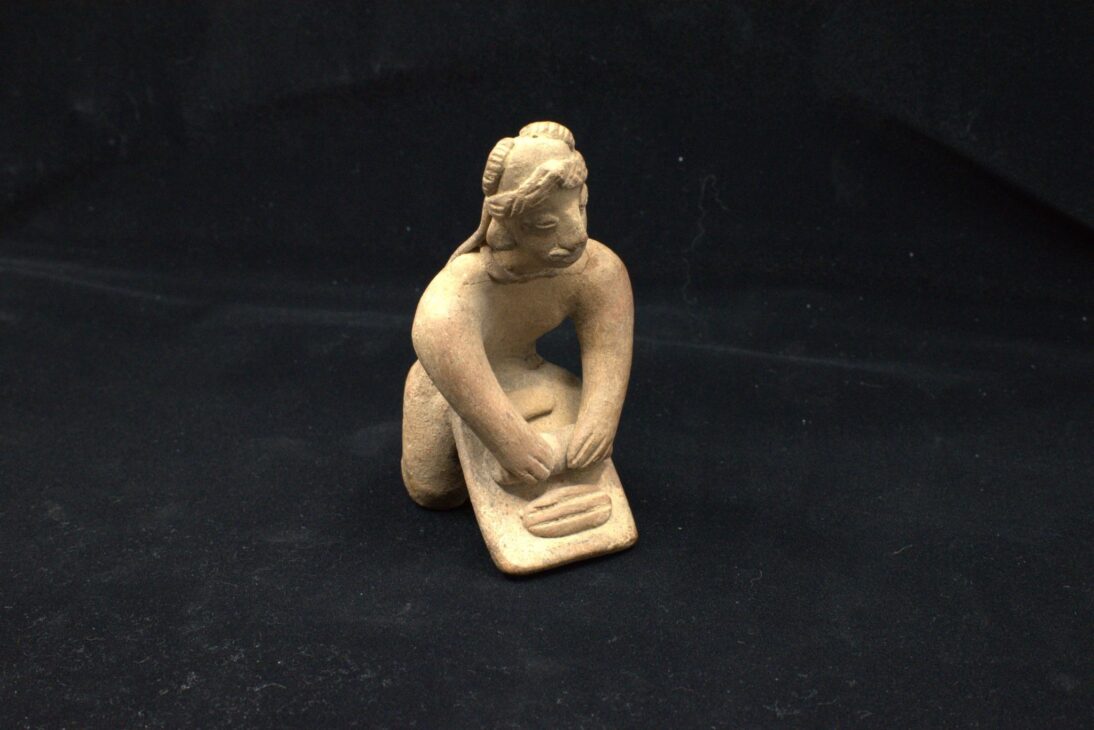
The Tuxcacuesco-Ortices region of western Mexico provides importance evidence daily life, labor, and ancestral ritual in ancient Mesoamerica.1 The ceramic figure, Women Grinding Corn, currently located by the UC Santa Barbara Art, Design & Architecture Museum reveals not only its original function but also the history of a broken system of mislabeling and circulation of cultural objects, shifting cultural contexts through the object's biography.2 Uncovering the figurine's journey, from a looted from shaft tomb, to a private collection, and ultimately to a university collection demonstrates how the system of extraction contributed to some modern museum collections of Mesoamerican artifacts.3 By examining the object biography, Woman Grinding Corn reflects the broader patterns of colonization, collecting, and the displacement of Indigenous heritage in mid twentieth century western Mexico.
The history of Woman Grinding Corn exemplifies the complex histories of western Mexican looting, nationalist governing of artifacts, and the hidden networks of collectors and dealers who moved cultural objects far from their origins. An object biography is the method that documents the life history of an artifact from how it was made, who interacted with it, to where it ends up. Tracing the figurine's movement and object biography across borders and institutions reveals its current status at AD&A Museum as an example of a larger historical process.4 Christopher Beekman explains that the entire twentieth century saw pervasive looting in western Mexico, often producing objects with no recorded provenience, deeply altered meanings once removed from their contexts.5 Monica Achim and Joshua Leathem describe how national collecting policies and the art market demand enabled the mass circulation of objects through hidden channels.6
Physical Condition:
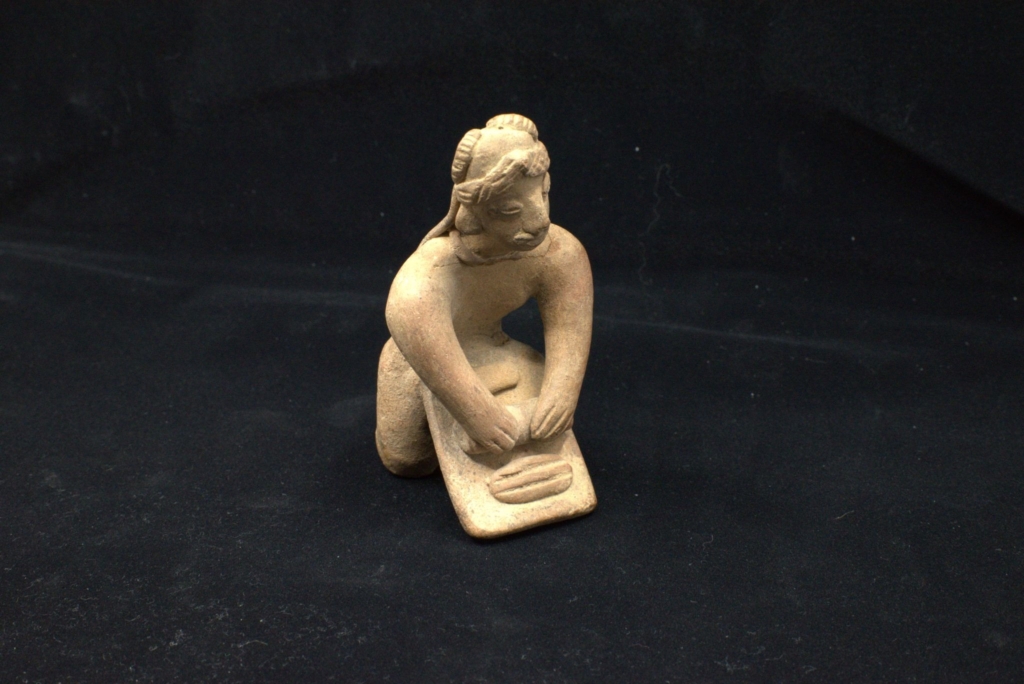
At the same time, the Women Grinding Corn physical condition including surface weathering, and fractures suggests a burial history of looting in Jalisco or neighboring regions. The figurine exhibits a fine brown clay body, long limbs, a metate, bulging eyes, and a head wrap. The figurine’s kneeling posture, leaning torso, and extended arms using a metate. The broad facial features and protruding eyes and the hairstyle, formed by a headwrap, is typical of Tuxcacuesco-Ortices style. (Fig 1).7 Through registar documents, collectors archives, and environmental factors in Mexico reconstruct not only the objects displacement, but also how museums work with the absence of information created by looting.8 Treating the figurine as an archaeological artifact and a witness to its own removal, can demonstrate how object biographies depict cultural loss. Woman Grinding Corn is not only an ancient object in ceramic but also a modern object shaped by shifting cultural, political, and institutional forces.
Object Biography:
Reconstructing the modern biography of Woman Grinding Corn reveals an object that has passed through multiple personal, national, and institutional contexts, each of which obscured aspects of its cultural identity.9 The earliest known point in its modern history begins with a New Zealand pilot working in Mexico for the presidents in the mid twentieth century.10 According to the AD&A Museum records, the pilot acquired the figurine during his time in Mexico.11 Although it is unclear how he acquired it, the timing and location suggest that the figurine originated in the looting sites of Jalisco, Nayarit, or Colima.12 The pilot, who owned silver mines near these looting sites, transported them to the United States, eventually settling in Los Angeles.13 Once the pilot passed, an attempt to sell to a museum in Spain failed, being eventually sold to a Canadian museum and put in a bathroom for makeshift storage for fifteen years.14
This transfer marked the figurine’s first entry into an institutional setting, but it did little to restore its cultural context. Eventually the museum offered the collection to new homes with this figure and other parts of the collection being bought by Caroline Tupper in the early 80’s from an auction in Pikesville Tennessee. Caroline Tupper had a fascination to mesoamerican artifacts due to working in an authenticating office in her professional life dealing with artifacts from around the world.15 Its eventual arrival at the UC Santa Barbara AD&A Museum was the result of a donation, not a targeted acquisition.16 Once at the AD&A Museum, the object received a classification of being from the state of Colima, however mislabeled by reliance on donor descriptions.17 This highlights a pattern identified by Achim, in which museums, to expand their collections, accept undocumented objects.18 Without provenance records, excavation data, or comparative analysis, museums further obscured its cultural distinctions.
Bigger Timeline:
The object biography of Woman Grinding Corn is not an isolated incident, it reflects a larger pattern shaping museum collections throughout North America. West Mexican tomb objects entered museums through undocumented channels in an astonishing amount in the late nineteenth and twentieth centuries, a period when collecting practices are very different than what they are today.19 As Beekman explained, the majority of the known West Mexican figurines in museums lack provenance and are effectively "archaeologically orphaned."20 Their disconnect from the sites is not an accident but is the result of looting, unregulated export, and questionable acquisition practices.21 Other examples similar to Woman Grinding Corn to other West Mexican objects exist with similar histories. The Walter Art Museum Group of Figurines and Architectural Model has its objects provenance listed as John G. Bourne [date and mode of acquisition unknown]; Walters Art Museum, 2009, by gift (Fig 2).22 Several figurines depicting domestic scenes share striking formal similarities with the AD&A Museum example, including the kneeling posture, simple facial modeling, and representation of daily activities.23 Despite their aesthetic similarities except in material, they have the same history that are worlds apart. The AD&A Museum figurine falls into a category, like many other ancient works, in which objects are culturally and stylistically valuable but constrained by contextual loss.
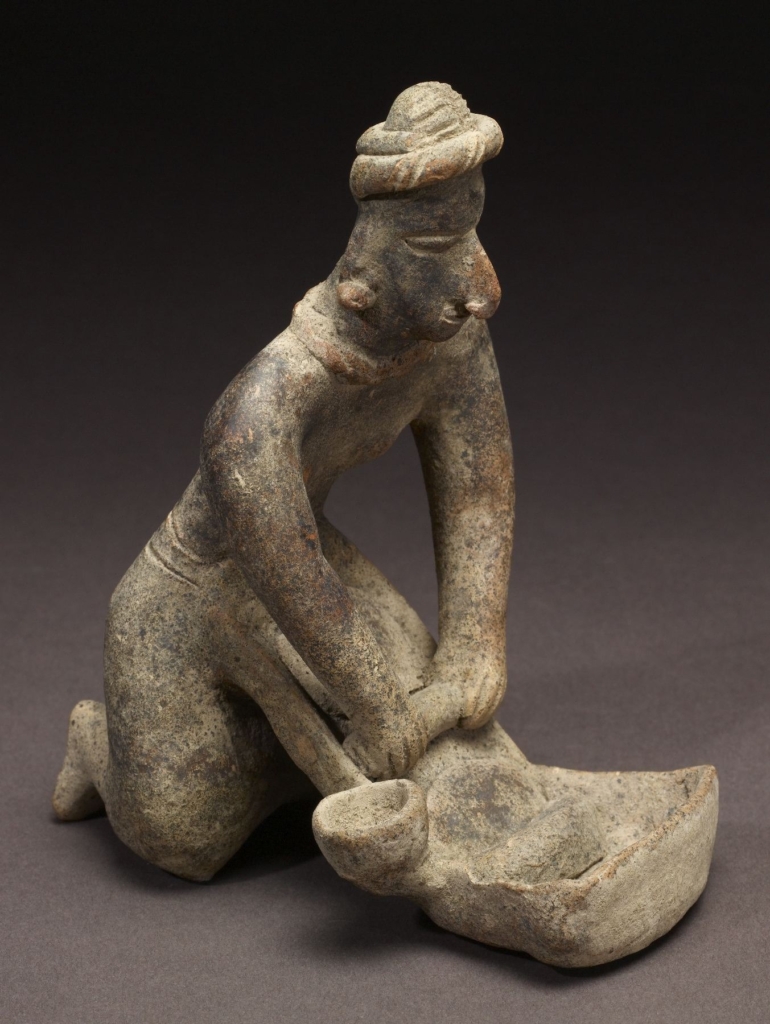
These comparative examples reinforce the general argument that the object biography of Woman Grinding Corn from Mexico to Canada into the AD&A Museum exemplifies the dominant patterns of antiquities circulation for West Mexican ceramics.24 The fact that its biography is missing certain parts of its history. It is not a failure on the part of a single event but rather a structural consequence of economic problems, lack of regulation, and international demand for ancient mesoamerican objects.25
The presence of shaft tombs in looting sites, defined as deep vertical burial shafts with multiple chambers filled with artifacts has defined the archaeological landscape of western Mexico.26 Primarily found in Jalisco, Colima, and Nayarit, these tombs remained largely unknown to the broader public until the twentieth century.27 By the time the public became aware of them, many had already been looted.28 According to Christopher Beekman, by the mid-1900s, looting in this region became "systemic and industrialized," feeding a market that desired the objects associated with the shaft tomb tradition.29 The archaeological record had already been altered with most objects entering circulation losing any context that could connect them to specific sites, communities, or funerary practices. Beekman sees this looting practice not only as a product of economic demand but also linked to systemic inequalities within rural western Mexico.30 Locals experiencing land pressures, agrarian reform, and lack agricultural resources would often loot as supplemental income.31 The looting of objects like Woman Grinding Corn cannot be understood purely as theft but reflects a social landscape where looting became part of survival.32
Being a local activity, the effects ended up being deeply associated with the larger art market. As Leathem explains Mexico's cultural patrimony laws, prior to the 1972 Federal Law on Archaeological, Artistic, and Historical Monuments and Zones, regulations were inconsistent and often ambiguous, allowing both Mexican nationals and foreign visitors to acquire objects with ease.33 Tourists, collectors, diplomats, and travelers like the New Zealand pilot who once owned Woman Grinding Corn could acquire objects without consequence.34 Museum collectors and dealers would complicate attempts at identifying by frequently misidentified, or mislabeled, objects from this region due to limited information of the area.35 Achim explains how collectors and institutions sought to categorize and control Mexico's ancient heritage, often with little knowledge of regional styles and cultures.36 Woman Grinding Corn, being labeled as coming from Western Mexico, Colima aligns with Achim's observation that institutions often obscured cultural distinctions into a single cultural zone in the name of building collections.
Authentic or Forgery?:
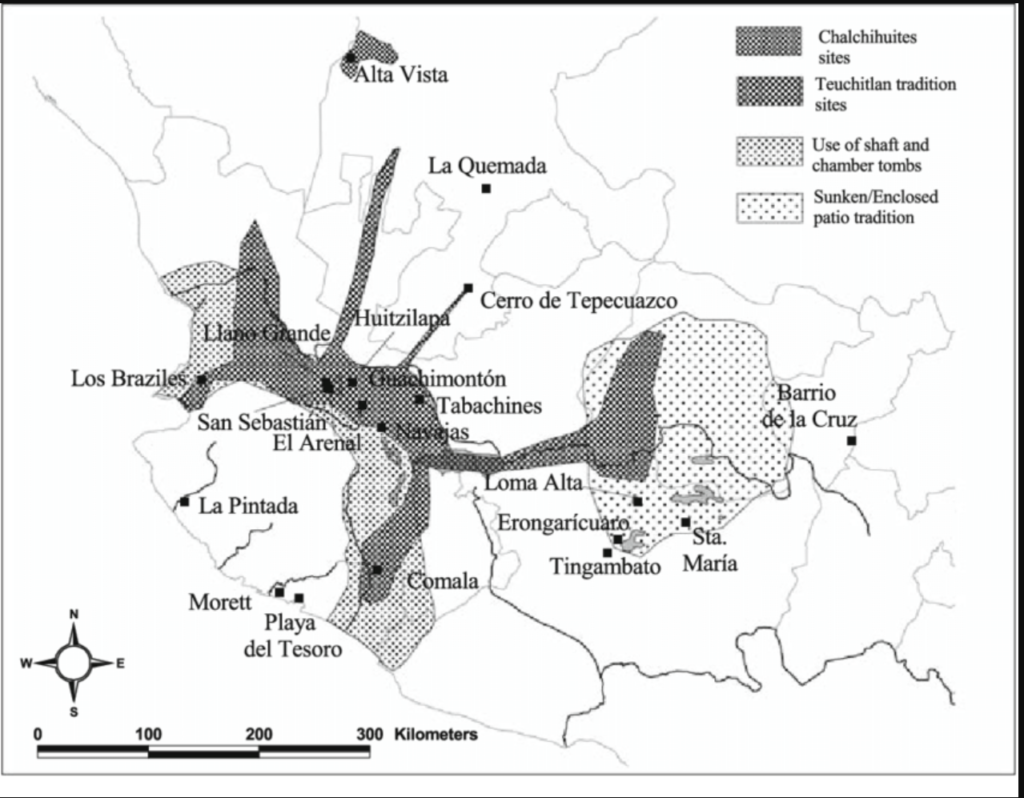
The market for antiquities was further complicated by the presence of replicas and forgeries.37 Alexandria Reynolds-Kaye explains how the production of fakes and replicas was seeping into the antiquities trade. As replicas circulated at the same time as authentic objects, it was difficult for buyers to distinguish between original artifacts and reproductions.38 This uncertainty shows the demand for more objects on the market and can lead more sites to be looted. Economic pressures, uneven regulations, market demand, museum misattribution, and replicas all shaped the trajectories of objects leaving the region.39 Within this context, the figurine's life from a burial context to a pilot's collection and to the AD&A Museum is ordinary. The broader forces outlined by Beekman, Achim, Reynolds-Kaye, and Leathem all contribute to the biography of this object.The physical surface of the Woman Grinding Corn provides some of the most powerful evidence of its original context and of its subsequent removal. The figurine exhibits a fine brown clay body, long limbs, a metate, bulging eyes, and a head wrap. These characteristics reflect the Tuxcacuesco–Ortices style from the Colima culture, particularly near Tuxcacuesco in southern Jalisco as the soil type in the area matches the material of Woman Grinding Corn rather than Colima where Ortice is located (Fig 3).40
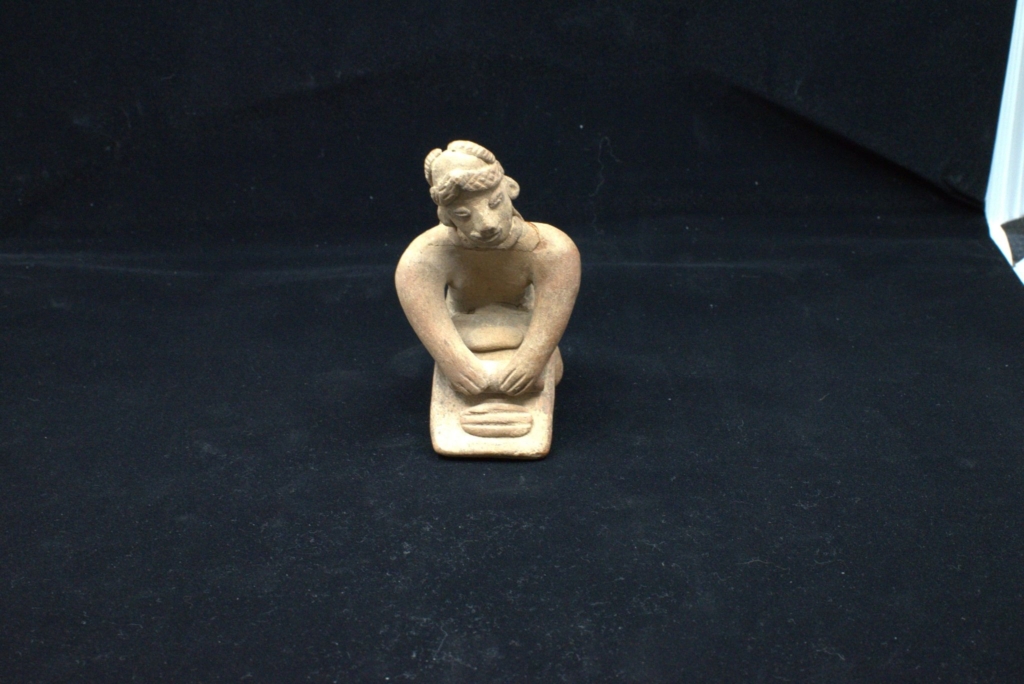
One of the strongest arguments for placing the figurine’s origin in Jalisco rather than Colima lies in the state's different soil composition. Southern Jalisco’s volcanic soils being mixed from ash layers and loose basaltic material from the Volcan de Colima tends to be softer, flexible, and lighter compared to the denser, darker, harder, clay-rich soils of neighboring Colima (Fig 4).41 These softer soils affect the preservation of ceramics in predictable ways and the objects themselves.42
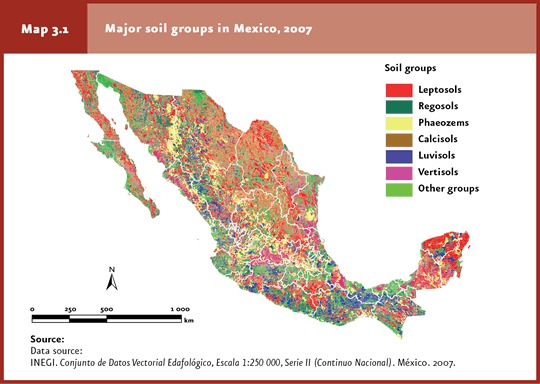
The surface condition of Woman Grinding Corn aligns more closely with Jalisco’s softer soil environment being Regosols soil and resources to make the actual figurine itself.43 The fine smoothing within the recesses of the metate and the how smooth and malleable the material seems indicates gradual friction to cause a smoothing effect from shifting volcanic soils, rather than the compacted clay pressure that can be caused by the Colima soil being Leptosols.44 The figurine’s brown clay body further corresponds to Tuxcacuesco ceramic compositions, which frequently include volcanic-derived inclusions absent from Colima’s more uniform red-slip traditions from the Comala style and dark stone from the Ortices location.45 This environment and material evidence strengthens the argument that the figurine originated in a Jalisco looting site, where softer soils would have contributed to the specific color, texture, and patterns visible today (Fig 4).
Looting sites due to the soil content and make up in Southern Jalisco usually maintain stable humidity, creating such effects on the figure. These environmental traces on the figure show that the figurine was not produced for tourist markets or modern replica workshops, it was almost certainly created around 200BCE to 200CE from the weathering patterns on the figurine.46 The figurine’s material and surface characteristics both support a Jalisco provenience over a Colima one. The figurine also shows structural stress associated with tomb looting. The crack on the leg matches well with the kind of damage commonly observed in objects removed.47 Looters in the mid twentieth century are well documented to have often used improvised tools to pry objects and frequently caused breaks in thin areas such as limbs.48
The figurine's formal qualities further situate it within the Tuxcacuesc Ortices style of southwestern Jalisco and Colima, dating roughly between 200 BCE and 200 CE. This region is known for producing domestic scenes depicting mainly women engaging with labor such as s, grinding maize and cooking. The figurine’s kneeling posture, leaning torso, and extended arms interacting with a metate match excavated examples in Tuxcacuesco-Ortices ceramics.49 The broad facial features and protruding eyes align closely to excavations in the region done later on. The hairstyle, formed by a headwrap, is typical of Tuxcacuesco-Ortices style. Material is the main differentiation in where it was looted from. Terracotta in Tuxcacuesco compared to limestone and harder material in Ortices. The metate is a crucial identifying feature.The Tuxcacuesco-Ortices culture had a higher degree of female labor representation signifying domestic stability and fertility.50 Unlike other Colima style figures, which often depict movement or animal-human hybrids, Tuxcacuesco-Ortices style tends to emphasize domestic labor.
Counterarguement:
A possible counterargument to the argument of the object biography may be that the figurine is not ancient at all but could instead be a forgery.51 Western Mexico has a long history of modern workshops producing figurines inspired by ancient Mesoamerica, especially beginning in the 1940s.52 If Woman Grinding Corn was within this larger commercial tradition, its lack of provenance before the pilots' acquisitions could reflect a modern souvenir transaction over looting. Instead, the biography might simply represent a more legal movement, the interest of a decorative or symbolic object into a global art market that sought ancient mesoamerican artifacts. An argument along these lines would frame the figurine not as a looted object but as part of a long-standing tradition of artisan production responding to economic opportunities and fascination with ancient objects.53
However, multiple pieces of evidence contradict this. The figurine’s material and morphological characteristics match excavated Preclassic and Early Classic figurines that are similar in the modeling of the metate, facial proportions, and smooth features that are difficult to accurately replicate in modern workshop, which tend to fire at different temperatures and have distinct surface texture.54 The figurine weathering within recesses of the metate and under the figure’s arms is consistent with long-term burial and inconsistent with mid-century reproductions.55 The broken parts exhibit a common type of post looting breakage seen on non workshop reproductions, which are fabricated, fired, and sold with little damage.56 Even the figurine’s museum biography supports its authenticity from a private collection, mislabeled, lack of documentation, aligns more closely to looted objects that entered the market informally.57 Despite the argument that shows the risk of assumed authority without a clear provenance, physical evidence, stylistics and environmental evidence favors the interpretation that Woman Grinding Corn is an ancient object displaced through mid-century looting networks.
Conclusion:
The biography of Woman Grinding Corn provides a view through which sees the history of looted West Mexican artifacts and their circulation into North American collections. The historical record of looting in Western Mexico, the analysis of the figurine, informed by geographic and soil types in Mexico, reconstructing the figurine's journey through private and institutional collections provides insight into the practices of mid century collectors and the effects of storage, damage, and repair.58 Evidence supports the fact that Woman Grinding Corn is an ancient, funerary object affected by the widespread looting practices of its era.59 Reconstructing its journey reveals the powerful economic, political, and institutional forces that drive cultural objects far from their places of origin.60 The challenges surrounding provenance shows the need for authenticity, and ethical stewardship remains central to understanding such objects today.61 The journey of Woman Grinding Corn is a small part of the broader story of Mexican shaft tomb ceramics, offering insight into both historical injustices and contemporary responsibilities for care and stewardship in museum contexts.62
Notes:
- Nelson, Sarah. Western Mexico Shaft Tombs and Their Ceramics: An Archaeological Survey. Austin: University of Texas Press, 2018, 22.
- University of California, Santa Barbara. Art, Design, & Architecture Museum Registrar’s Office Records. Folder 2017.015.013, Caroline Tarbell Tupper Collection of Pre-Columbian Art.
- Taylor, R. E. “The Shaft Tombs of Western Mexico: Problems in the Interpretation of Religious Function in Nonhistoric Archaeological Contexts.” American Antiquity 35, no. 2 (1970), 160.
- Achim, Miriam. “Introduction: A Mexican Cabinet of Unlikely Things.” In Museum Matters: Making and Unmaking Mexico’s National Collections, edited by Shelly Rozental, Susan Deans-Smith, and Miriam Achim, 1–20. Tucson: University of Arizona Press, 2021, “Introduction,” 8.
- Beekman, Christopher S. Branding Western Mexico: How Collectors and Dealers Reshaped the Archaeological Discourse. Los Angeles: J. Paul Getty Trust, 2024, 44.
- Leathem, Hilary Morgan V. “Looting Made Legal: Settler-Colonial Logics of Erasure and the Making of Phantasmal Patrimony.” Current Anthropology 66, no. 2 (2025): 156–182, 170.
- Nelson, Shaft Tombs, 41.
- AD&A Museum Registrar Files.
- Beekman, Branding Western Mexico, 57.
- AD&A Museum Registrar Files.
- AD&A Museum Registrar Files.
- Nelson, Shaft Tombs, 33.
- AD&A Museum Registrar Files.
- AD&A Museum Registrar Files.
- AD&A Museum Registrar Files.
- AD&A Museum Registrar Files.
- Achim, “Introduction,” 12.
- Achim, “Introduction,” 15.
- Beekman, 71.
- Beekman, 73.
- Leathem, “Looting Made Legal,” 175.
- The Walters Art Museum. “Group of Figurines and Architecture Model,” Folder 2009.020.33.7, Figure from Small Figural Group.
- Walters Art Museum Object File 2009.20.33.7
- Beekman, Branding Western Mexico, 89.
- Leathem, 176.
- Nelson, 55.
- Nelson, 58.
- Pickering, Robert B., and Christopher S. Beekman. “A Personal Homenaje to Phil Weigand.” Ancient Mesoamerica 17, no. 2 (July 2006), 235.
- Beekman, 103.
- Leathem, 168.
- Leathem, 168.
- Pickering, 237.
- Taylor, 166.
- Taylor, 169.
- Achim, 18.
- Ibid., 19.
- Reynolds-Kaye, Jennifer. “Museum Replicas: Recovering the Work of Making Plaster Casts of Pre-Columbian Art.” In Oxford Handbook of Museum Archaeology, edited by Alice Stevenson, 450–469. Oxford: Oxford University Press, 2022, 452.
- Reynold-Kaye Jennifer, “Museum Replicas”., 459.
- Taylor, 163.
- López Austin, Alfredo. The Cultural History of Maize in Ancient Mesoamerica. Mexico City: Fondo de Cultura Económica, 2015, 31.
- Secretaría de Medio Ambiente y Recursos Naturales (SEMARNAT). “Soils of Mexico.” Informe 2008. Published 2007. https://apps1.semarnat.gob.mx:8443/dgeia/informe_2008_ing/03_suelos/cap3_1.html.
- SEMARNAT Soil Data.
- Nelson, 80.
- SEMARNAT Soil Data.
- Nelson, 83.
- Nelson, 92.
- AD&A Museum Records.
- Beekman, 95.
- Nelson, 102.
- Nelson, 104.
- Taylor, 161.
- Reynolds-Kaye, 458.
- Nelson, 115.
- Nelson, 118.
- Nelson, 121.
- Beekman, 109.
- Pickering, 237.
- Achim, 20.
- Beekman, 137.
- Leathem, 180.
- Taylor, 150.
- Nelson, 140.
Bibliography:
Achim, Miriam. “Introduction: A Mexican Cabinet of Unlikely Things.” In Museum Matters: Making and Unmaking Mexico’s National Collections, edited by Shelly Rozental, Susan Deans-Smith, and Miriam Achim, 1–20. Tucson: University of Arizona Press, 2021.
Beekman, Christopher S. Branding Western Mexico: How Collectors and Dealers Reshaped the Archaeological Discourse. Los Angeles: J. Paul Getty Trust, 2024.
Taylor, R. E. “The Shaft Tombs of Western Mexico: Problems in the Interpretation of Religious Function in Nonhistoric Archaeological Contexts.” American Antiquity 35, no. 2 (1970): 160–69. https://doi.org/10.2307/278145.
Instituto Nacional de Estadística, Geografía e Informática. Cuaderno estadístico municipal: Ixtlán del Río, Estado de Nayarit. Mexico City: Instituto Nacional de Estadística, Geografía e Informática, 1995.
Leathem, Hilary Morgan V. “Looting Made Legal: Settler-Colonial Logics of Erasure and the Making of Phantasmal Patrimony.” Current Anthropology 66, no. 2 (2025): 156–182.
López Austin, Alfredo. The Cultural History of Maize in Ancient Mesoamerica. Mexico City: Fondo de Cultura Económica, 2015.
Nelson, Sarah. Western Mexico Shaft Tombs and Their Ceramics: An Archaeological Survey. Austin: University of Texas Press, 2018.
Pickering, Robert B., and Christopher S. Beekman. “A Personal Homenaje to Phil Weigand.” Ancient Mesoamerica 17, no. 2 (July 2006): 235–37. https://doi.org/10.1017/s0956536106060159.
Reynolds-Kaye, Jennifer. “Museum Replicas: Recovering the Work of Making Plaster Casts of Pre-Columbian Art.” In Oxford Handbook of Museum Archaeology, edited by Alice Stevenson, 450–469. Oxford: Oxford University Press, 2022.
University of California, Santa Barbara. Art, Design, & Architecture Museum Registrar’s Office Records. Folder 2017.015.013, Caroline Tarbell Tupper Collection of Pre-Columbian Art.
The Walters Art Museum. “Group of Figurines and Architecture Model,” Folder 2009.020.33.7, Figure from Small Figural Group.
Secretaría de Medio Ambiente y Recursos Naturales (SEMARNAT). “Soils of Mexico.” Informe 2008. Published 2007. https://apps1.semarnat.gob.mx:8443/dgeia/informe_2008_ing/03_suelos/cap3_1.html.