Acknowledging our History and Land
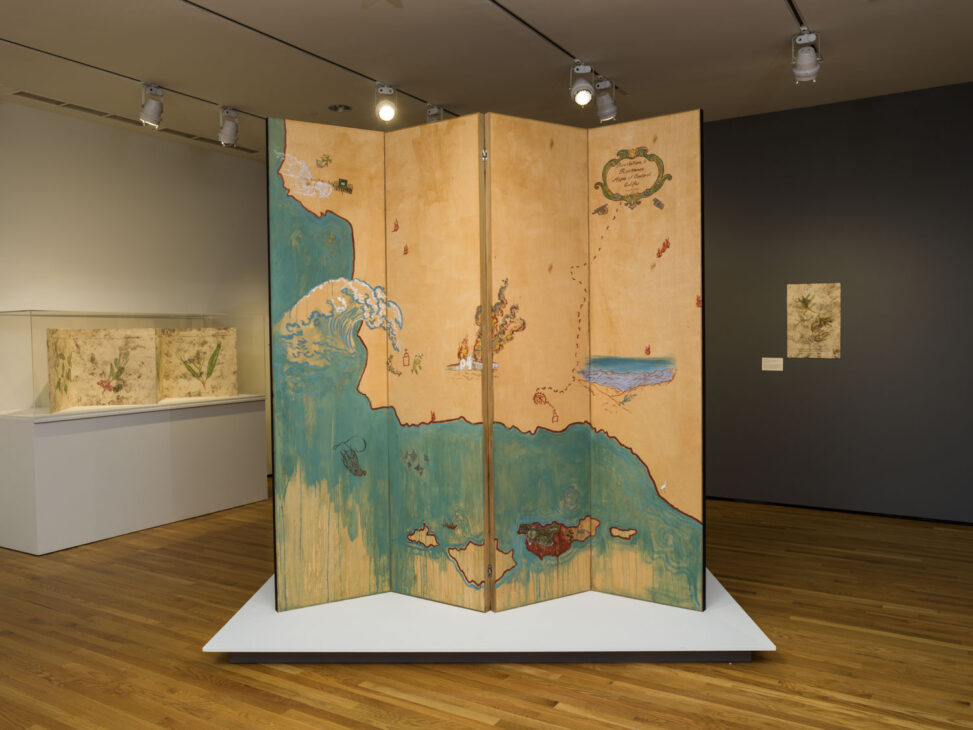
Sandy Rodriguez (b. United States, 1975), Revolution & Resistance Mapa of Central Califas from the Codex Rodriguez-Mondragón Recto/Front: Mapa of Central Califas Verso/Back: Nocturne: view of mainland from limuw/Santa Cruz Island, 2023. Hand-processed pigments, abalone, oil on panel. Courtesy of the artist. © Sandy Rodriguez
The Art, Design & Architecture Museum at the University of California, Santa Barbara honors with gratitude and respect the Coastal Chumash, who have stewarded since time immemorial the land where the Museum resides. We acknowledge that UC Santa Barbara is built on the unceded territory of the Chumash Nation and their ancestral villages of Heli-yuk, Anisq’oyo, and Helo’.
We recognize centuries of forced removal, corporeal violence, enslavement, and deception as the structural reasons why we reside on this land today. As an institution with a collection of artworks and cultural objects, we exist within a colonial history of dispossession and strive to engage in ethical practices of collection, preservation, and display. As a teaching museum within a university, we recognize our responsibility to highlight Indigenous knowledge and cultural production. As an arts organization with a regional identity, we are committed to platforming local Native artists through commissions, exhibitions, and educational programs.
We invite all to join us in support of Chumash sovereignty and their right to self-determination by practicing actions that bring justice to past, present, and future Native stewards of these lands that sustain life.
This land acknowledgment is a living document that will continue to be revised and strengthened in collaboration with community members over time. This statement was last updated in May 2025.
Occupying the Land
1862 marked the beginning of the “Land-Grant University” through the passage of the Morrill Act, which proposed to reallocate surplus land originally earmarked for the building of the Transcontinental Railroad. Notably, however, the Morrill and Pacific Railroad Acts presumed that the land was unoccupied. Millions of acres of land were forcibly taken from more than 250 Indigenous Nations, with very few of them receiving any compensation. This injustice has led many to dub the universities established from the Morrill Act as “Land-Grab Universities.”
The first university established in California from the Morrill Act was the University of California, Berkeley in 1868, leading the way for the University of California system. As UC Santa Barbara student Hannah Z. Morley reports, “UC Berkeley received 148,636 acres of land, none of which the U.S. government paid the first inhabitants for, and the university made $730,860 from this endowment.” Yet, while UC Santa Barbara is part of the UC system, it did not acquire the land for its campus through the Morrill Act. Instead, it was purchased and incorporated into the system through another separate government entity: the United States Military.
In 1944, local politicians petitioned the Regents of the University of California for a new UC location, leading to the incorporation of the Santa Barbara State College into the UC. Four years later, in 1948, the UC Regents acquired land in Goleta through the military, relocating from downtown Santa Barbara to Goleta by 1954. This land, which had formerly been used as a Marine Corps Air Station during World War II, is where UC Santa Barbara currently resides.
Throughout the 1930s, air travel into Santa Barbara became popular, and in the 1940s, the airport underwent significant development with the passage of the Federal Airport Act, designed to bolster aviation infrastructure on the West Coast as WWII intensified. Eventually, it was decided that the military would acquire the airport and the entirety of the Goleta Mesa.
The airport sits on top of the Goleta slough, a natural wetland filled in for the airport construction. Yet, the slough was not empty. At the center of this diverse ecosystem was Mescaltitlán Island—named as such by the Spanish for its resemblance to Mexcaltitán, an island city in Nayarit, Mexico. This landmass today has been reduced to a dirt mound on the side of the freeway.
While this history accounts for the involvement of private interests and the federal government's control of the land, it overlooks the Indigenous stewards and inhabitants who were present before the missionization of California. Goleta was once home to a thriving population of Chumash people, oak trees, and other native wildlife. It is cited that hundreds of Chumash homes were in this community called Helo’. According to Michael A. Glassow, UCSB Department of Anthropology Professor Emeritus, in his book Goleta Slough Prehistory: Insights Gained From a Vanishing Archaeological Record (2020), humans lived in Goleta for at least 10,000 years. By the 1700s, there were at least four large Chumash villages, likely home to as many as 2,000 to 10,000 individuals.
History of the Chumash People
Since time immemorial, the maritime Chumash people have called Southern California’s coastline and Northern Channel Islands home. The Chumash are comprised of the descendants of Indigenous peoples removed from their land or island of origin, Limuw (Santa Cruz), Anyapac (Anacapa), Wima (Santa Rosa) and Tuqan (San Miguel), from present-day Malibu to Morro Bay and inland to Bakersfield. Today, the Chumash remain one of North America’s longest existing civilizations.
With the arrival of Spanish colonizers in the late 1700s, traditional Chumash life was completely uprooted. Between 1769 and 1833, the Chumash were subjugated by five out of the twenty-one missions during Spanish colonization. Mission campaigns targeted Chumash ancestral stewardship of the land through incarceration and forced labor, leading to cultural breakdown and population loss due to genocidal violence and disease.
Between 1786 and 1804, a large majority of the Chumash population was brought into the missions. In 1824, the Chumash Revolt at Mission Santa Inés marked a powerful act of Indigenous resistance against colonial power. The uprising quickly spread to nearby missions, with Chumash seizing control of their ancestral lands and confronting Spanish soldiers in one of California’s largest and most organized Indigenous uprisings.
Following the period of Mexican occupation and mission secularization, the U.S. government refused to uphold agreements with the Chumash, including rejecting treaties that would have granted them rightful stewardship of the land. Instead, Chumash communities faced continued displacement, discrimination, and disrespect of their rights under American westward expansion.
In 1901, the Santa Ynez Band gained federal recognition, and while they remain the only recognized Chumash Nation today, other Chumash bands continue to fight for cultural and political recognition. Today, the Santa Ynez Chumash Museum and Cultural Center serves as a place for cultural education and community engagement, offering immersive experiences that honor Chumash history and promote the continuation of their traditions.
Chumash Architectural and Design Innovations
Chumash society is rooted in a profound knowledge of the land, emphasized through a special and sustainable relationship with natural resources. With access to coastal, inland, and island trade networks, Chumash communities have thrived with an abundance of natural goods and manmade tools. For example, the California bulrush, also known as tule or stapan, is utilized traditionally in many architectural and design innovations, including as roof thatching, sleeping mats, privacy partitions, and tule balsas, a type of watercraft made by tying bundles of dried tule together that are stiffened with willow poles. Also made out of willow poles and bulrush, the Chumash ‘Ap is a domed home, most known for its distinct thatched roof where bulrush is added in layered rows, overlapping the preceding layer, creating a modern shingle effect.
To navigate the local water sources, master artisans carved plank canoes from redwood logs, known as tomols, effectively establishing the Chumash as expert mariners. Tomols also incorporated bulrush, as the gaps between their planks were filled in with the pithy heart inside the stems before being waterproofed with tar. Actively engaged in preserving and revitalizing their cultural heritage, the Chumash hold a significant annual event known as the Tomol Channel Crossing, where Chumash paddlers navigate tomols across the Santa Barbara Channel to the island of Limuw (Santa Cruz). This 23-mile journey not only honors their maritime heritage but also strengthens community bonds and reaffirms a connection to their homelands.
Chumash Artistic Production
The Chumash’s complex society and stable economic systems allowed for the flourishing of artistic traditions, both practical and aesthetic. Among their most celebrated contributions is basketry, an artform deeply connected to their environment. Harvesting and preparing native plants such as basket rush or mekhme’y, Chumash artists weaved baskets that ranged from practical everyday items to sacred ceremonial objects. These baskets reveal a close relationship between material, practice, and the natural world, an ethos and artistic knowledge that continues to be passed down through generations.
Delicate shell bead money, known as ’alchum, played a central role in facilitating Chumash society, particularly among communities on the Channel Islands. Carefully crafted from local shells, this shell money became a cornerstone of the Chumash's trade networks, connecting inland and coastal communities, in addition to groups well beyond present-day California. That cultural importance is even reflected in their name: “Chumash” derived from Michumash, meaning “makers of shell bead money.”
Today, the Chumash continue to carry forward their rich traditions, history, and cultural heritage, reflecting the continued heritage of California’s Indigenous communities.
Related Exhibitions at the AD&A Museum
Shortly after being established as the University Art Gallery in 1969, the Museum mounted a brief but major exhibition devoted to the art of the Chumash, entitled Chumash Indian Art (April 21–May 17, 1964). Comprised of loans from across the country, Chumash Indian Art was one of the first exhibitions to survey Chumash basketry along with sculptures in stone and shell. Anthropological in its intent, the exhibition established Chumash material production within context while upholding Chumash ingenuity, skill, and aesthetic choice as typical for art objects. Unfortunately, however, the exhibition utilized past-tense language that reinscribes misplaced notions of the Chumash as extinct or belonging to the past.
Today, the AD&A Museum is committed to highlighting Indigenous art and histories through exhibitions. Most recently, Sandy Rodriguez – Unfolding Histories: 200 Years of Resistance (February 25, 2023–March 3, 2024) was an exhibition centered on resistance and uprising in Central California’s history, notably exploring the 1824 Chumash Revolt. The artist explores the use of local plants and pigments to create maps, and her processes explore techniques and materials drawn from numerous cultures and histories.
Other exhibitions, such as Ishi Glinsky: Upon a Jagged Maze (September 1, 2022–January 22, 2023) and Sacred Art in the Age of Contact: Chumash and Latin American Traditions in Santa Barbara (September 16–December 8, 2017), further this mission. Glinsky, a Tohono O’odham artist, reimagines Native craft traditions through contemporary sculpture and painting. Sacred Art, part of the Getty’s Pacific Standard Time: LA/LA initiative, explored the interconnectedness of Chumash and Spanish sacred art during the Mission period, presenting over 100 objects and emphasizing the endurance of Chumash artistic traditions. Together, these exhibitions reflect the museum’s commitment to honoring Indigenous voices and complicating colonial narratives.