Fetishes, Foreignness, and Footwear
Initially written for ARTHI 187A: Approaches to Objects
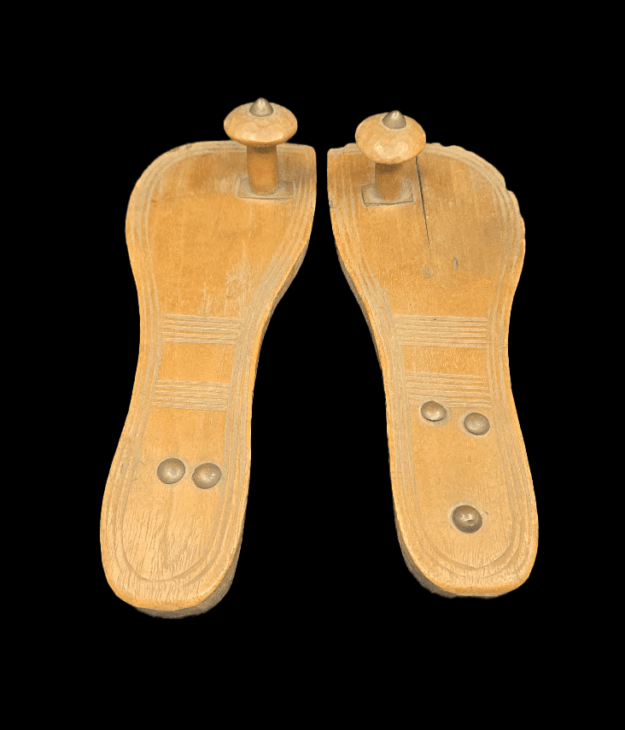
The AD&A Museum contains a pair of wooden sandals that are stated to have been found somewhere in Tanzania or Kenya, likely belonging to the Swahili people. The sandals consist of flat wooden soles that match the shape of a foot. They are nine inches long and three inches wide and likely belonged to a woman. No straps or other devices are securing the foot to the sandal other than a defining toe knob. These characteristics match that of the mitawanda, an evolution of the Indian paduka.

The name Paduka translates to ‘little foot’ and the term first appeared in the Vedic scriptures. Padukas are characterized by a thick, flat, usually wooden sole, often elevated. In early Sub-Saharan Africa, clothing and jewelry were seen as modifications to the body. Dress was more than just protection from the elements--it was essential to identity.
Padukas took on a new life in Africa as mitawandas. Mitawandas, sometimes referred to as clogs, became a marker of social class due to their exotic rarity and value as footgear. The majority of mitawandas were richly decorated, often having intricate carvings and ornaments. In the 1840s, the meaning of the mitawanda evolved and a new emancipated class appeared. These mitawandas went back to the more simplistic design of the original, padukas. This class wore the sandals as a marker of freedom and equality with the former elite class.

The sandals in the AD&A Museum’s collections, and other mitawandas or padukas, are useful tools in determining the way cultures have interacted throughout time. By studying the biographies of these objects, we can understand the fetishization of foreignness not only as it was present in Africa in the 18th century but also currently. Understanding this phenomenon as not an isolated occurrence but a regular one across time and cultures suggests that these ideas say less about the objects and the cultures and more about the human condition as a whole.
Sources:
Bell, Michael. Primitivism. London: Methuen, 1972.
Carey, Margret, Joanne B. Eicher, and Joanne Bubolz Eicher. “Africa: Dress.” Oxford Art Online, 2003. https://doi.org/10.1093/oao/9781884446054.013.60000100113.
DeMello, Margo. Feet and Footwear: A Cultural Encyclopedia. Westport, CT: Praeger, 2011.
Horton, Mark, and John Middleton. The Swahili: The social landscape of a mercantile society. Oxford: Blackwell, 2010.
“Permanent Collection Installations: Arts of Africa: Gallery Rotation.” Cleveland Art: Cleveland Museum of Art Members Magazine 62, no. 4 (2022): 12–13.
Jain-Neubauer, Jutta. Feet & Footwear in Indian culture. Toronto, New York: Bata Shoe Museum in association with Mapin Pub, 2000.