Cultured Butter

by Hazel Naftzger, Art, Design & Architecture Museum Intern
Butter sculpture lambs are a Catholic Easter tradition from eastern Europe. The lamb is a representation of Jesus as the Lamb of God, and red details like flags and ribbons are often included as symbols of the blood of Christ. The spread of butter lambs in the US can be traced in part to the Malczewski family, located in Buffalo, New York. Originally from Poland, the Malczewskis have sold butter lambs from their Broadway Market Grocery store since the 1960s.

Butter lambs have been a staple at my family’s Easter parties for years. Small, creamy, and white, the lamb, made by my uncle, would sit on the kitchen island (pictured below). Yet, butter is a sculpture medium used beyond the religious context.

Butter Art
Artists Jim Victor and Marie Pelton, from Conshohocken, Pennsylvania, were originally trained in traditional sculpting materials but transitioned to food sculpture in 2000. The sculptures use waste butter, so they are not edible, and the butter is recycled after their display in state fairs and other events, as reported by local media.
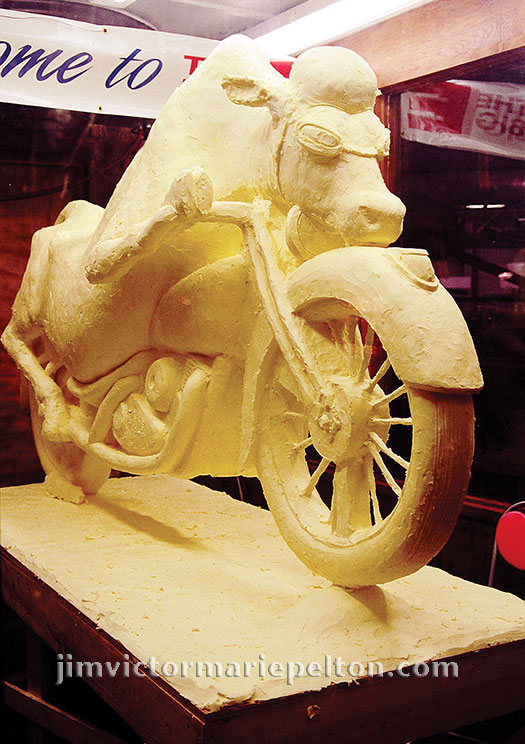
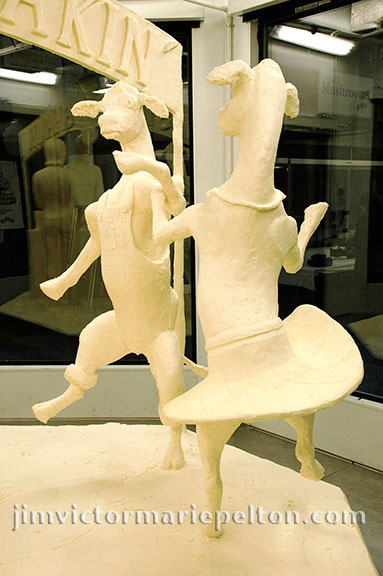
One of the first Americans to sculpt in butter was Caroline Shaw Brooks whose piece The Dreaming Iolanthe helped promote her farmer husband’s dairy products. Her butter sculptures were featured at art exhibitions in Cincinnati, Philadelphia, and at the Paris World’s Fair in 1878.

Several works at the AD&A Museum use butter or other foods as material or inspiration. Jane Callister's mixed media piece Butter-Cream-Fly is covered in cream-colored spackle with drips running down. There is a large cream-colored plastic fly that appears to be crawling across the canvas, lifting one set of legs off the canvas and leaving behind a trail of spackle as if the fly is crawling through butter.

Stephanie Washburn’s abstract photograph with a blue and white still from a TV screen shows what appears to be a crowd of people. The silhouettes of spaghetti and butter are visible over the screen.

David P. Bradley’s Land O Bucks, Land O Fakes, Land O Lakes includes butter in his activism art. Since 1928, Land O Lakes has featured a Native American woman kneeling on the ground holding butter in her raised hands on their logos. In 2006, David P. Bradley, of Indigenous Chippewa and Lakota descent, aimed to “combat cultural myths and the treatment of Native Americans” with his butter box artwork. He specifically spoke out against the commodification of the Native American identity with this work, as he wrote for the Denver Art Museum “For five hundred years, American Indians have had everything taken from them. One of the last valuable things they own is their identity. Now that Indian identity has become a marketable commodity, it is being taken, as well.”

In 2020, Land O Lakes removed the Native American woman from their labels and kept the land behind her.
This project emerged from the AD&A Museum Internship Program led by Victoria Jennings, the Murray Roman Curatorial Fellow and Internship Program Coordinator. To learn more about the Internship Program, please visit our website: https://museum.ucsb.edu/learn/internship