Paul Revere Williams and His Architectural Drawings in the Architecture and Design Collection


African American architect Paul Revere Williams (1894-1980) grew up in Los Angeles at the turn of the 20th century, as the city gained its metropolitan stature. From an early age, Williams showed an unconditional interest in becoming an architect and, against the vast racial prejudices of the time, he pursued a career in architecture, which he combined with studies in art and engineering. After working for prestigious firms in LA, in the early 1920s, he opened his own practice and became the first African American architect to join the American Institute of Architects. Earning himself a reputation among colleagues and clients thanks to his unique social and drafting skills, Williams’ early commissions for small affordable housing projects grew to include designs of banks, hospitals, hotels, alongside numerous residences for the upper middle class and the wealthy. Together with his competence to work at different scales (domestic, institutional, and urban), Williams mastered a variety of architectural styles (from Tudor to Colonial and from Georgian to Modern), demonstrating his capacity to prioritize his clients' stylistic preferences.
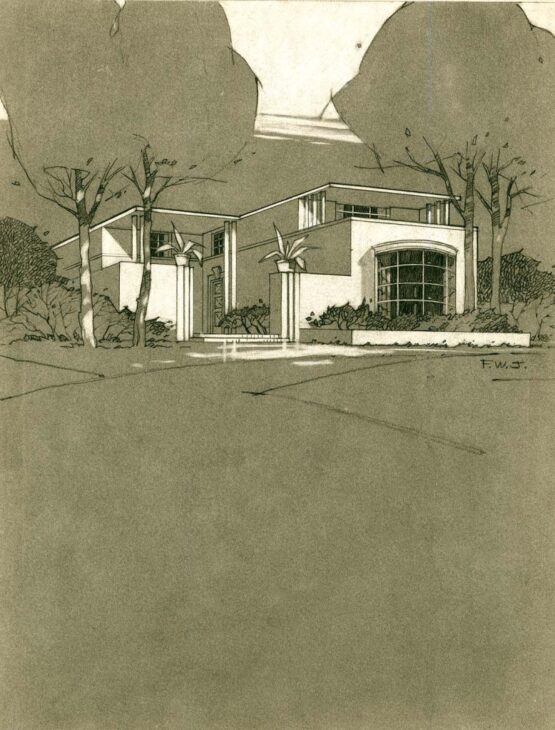
In 1946, Williams exhibited these particular abilities in the book New Homes for Today, an illustrated compilation of residential projects in an array of styles, headed by the architect’s recommendations for procuring a modern lifestyle. The drawings of the housing models featured here, preserved in the Architecture and Design Collection of the AD&A Museum, and reproduced in the book, epitomize the postwar architectural ideals of simplicity, flexibility, functionalism and openness. They are a minimal representation of the multifarious 3,000 designs Williams produced throughout his lifetime, working in a segregated environment, yet convinced of his right to equal opportunity. While his vast architectural legacy stands today as a testimony of William’s success in this endeavor, his words encourage the strength to overcome racial discrimination.
"I came to realize that I was being condemned, not by lack of ability, but by my color. I passed through successive stages of bewilderment, inarticulate protest, resentment, and, finally, reconciliation to the status of my race. Eventually, however, as I grew older and thought more clearly, I found in my condition an incentive to personal accomplishment, and inspiring challenge. Without having the wish to “show them,” I developed a fierce desire to “show myself.” I wanted to vindicate every ability I had. I wanted to acquire new abilities. I wanted to prove that I, as an individual, deserved a place in the world." (Paul Revere Williams, "I am a Negro," American Magazine, 1937)
Post contributed by Chester Battle, Visitor Services Manager, AD&A Museum.
Images: Paul Revere Williams drawings, Architecture and Design Collection. Art, Design & Architecture Museum; University of California, Santa Barbara. Click on each image for larger view.