UCSB Museum Showcases Extensive ‘Mexican Prints: Garcia-Correa Collection’
Local leaders, both children of migrant farmworkers, donate works reflecting campesino culture, politics and values
by Julia McHugh, Noozhawk Contributing Writer September 15, 2025 | 7:55 pm
Gil Garcia is a community leader, known as an innovative architect, former Santa Barbara City Council member and even a past Man of the Year.
However, as a young child living among other families of Spanish-speaking migrant workers, he thought he lived in Mexico. It was Goleta.
His father was a “campesino” (migrant farmworker) who came to America after the Mexican Revolution, eventually settling not far from the Santa Barbara Airport to work in local lemon, avocado and walnut groves.
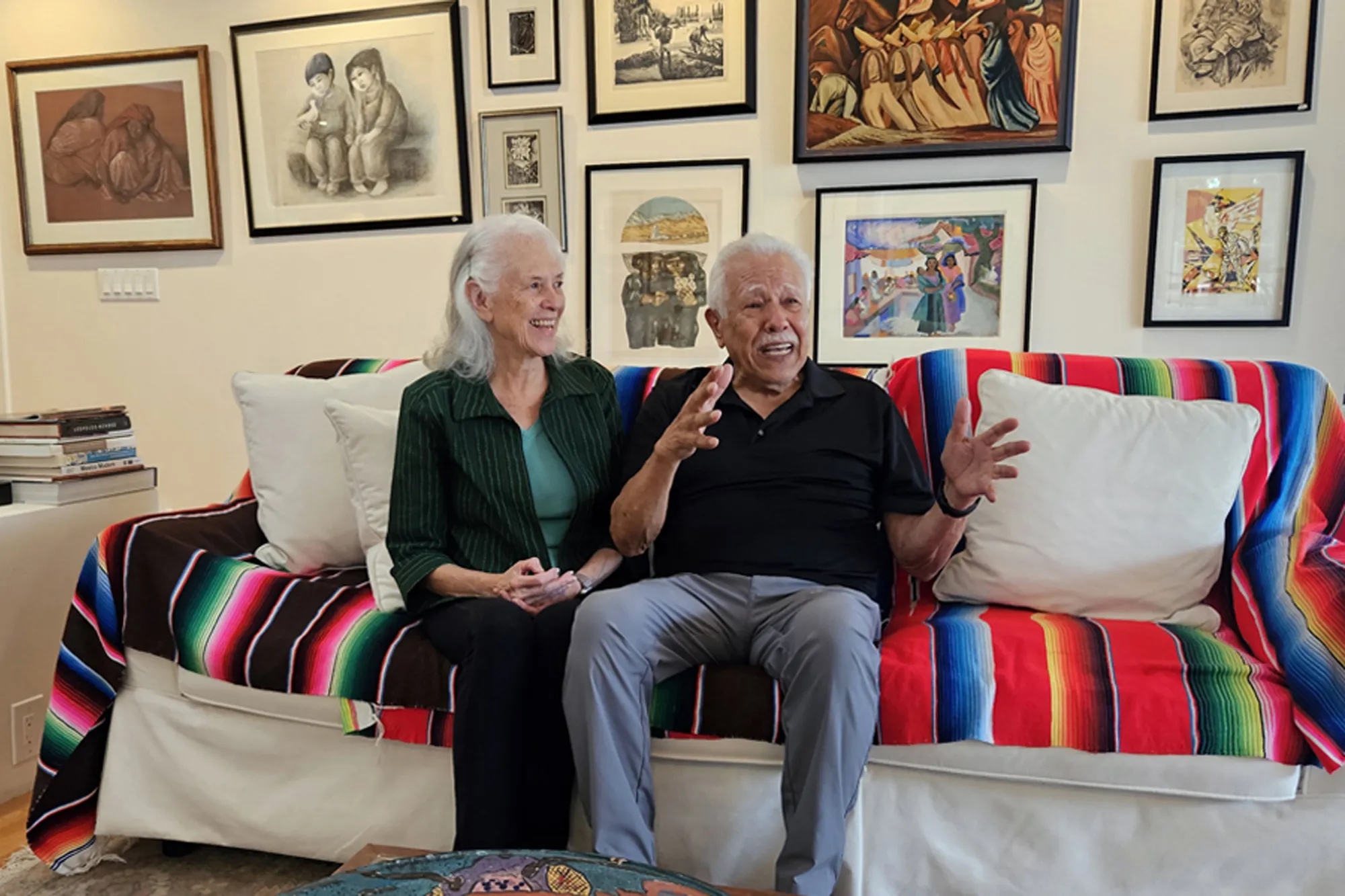
“The campesinos are anonymous heroes — the lifeblood of our economy,” Garcia said while sitting in his light-filled living room in Santa Barbara’s Upper East neighborhood.
The walls are covered with framed paintings and prints, and many more line the floor, propped against the walls. Sculptures are scattered on either side of the fireplace, and other cultural items fill the coffee table and shelves.
It’s but a portion of an extensive collection acquired over many years with his wife, Marti Correa de Garcia, also a child of campesinos.
The focus is on works by Mexican artists that illustrate campesino values and culture, Mexican history and architecture, along with works that have a personal meaning.
“Many of us sons and daughters of campesinos have achieved success here, once we overcame the cultural classes,” he said. “Marti and I were raised on core values of humility, honesty, teamwork and commitment to family.
“We feel that we owe it to them to gather art that reflects campesino and Mexican culture.”
That feeling extends further, as the couple have made several donations of artwork to the Art, Design & Architecture Museum at UC Santa Barbara, with more to come.
A new exhibit, “Mexican Prints: The Garcia-Correa Collection,” showcasing 31 lithographs, etchings and linocuts, opened Saturday.
It’s promoted as a preview for a future comprehensive exhibition. Admission to the UCSB museum is free, but on-campus parking is $8. Visit museum.ucsb.edu for hours and directions.
Two new exhibits showcasing the museum’s permanent collection are also on view.
Greeting visitors in the entry is “Sunflower” (1970), one in a series focused on the yellow flower species painted by Joan Mitchell during the last 20-plus years of her life. The single work comprises “Joan Mitchell 100,” commemorating the artist’s centennial birthday.
In the main gallery, “Beyond the Object” displays more than 20 recent acquisitions and gifts of paintings, sculpture, photography and works on paper. It represents the museum’s expansion of its modern and contemporary art collection.
The exhibit of the Garcias’ donations is hard to miss. Look for a wall painted in the vivid color that exhibit curator Ana Briz calls “rosa Mexicano” (“Mexican pink”).
“It’s a reference to Mexican architect Luis Barragán, known for his use of vibrant, saturated colors,” she said. “It’s fitting, as Gil is also an architect, and the color appears in several of the pieces.”
The museum recently acquired Barragán’s papers.
Hung against that vibrant backdrop are two lithographs by Emilio Amero highlighted with pink washes: “Muchacha peinándose el pelo” (“Girl Combing Her Hair,” 1950) and “Vendedor de flores” (“Flower Merchant,” 1958). Born in a small Mexican farming community, Amero later became a professor at the University of Oklahoma.
“We are having a Mexican mid-century modern moment here, spanning from the end of the Mexican Revolution through the 1980s,” said Briz, the museum’s assistant director and curator of exhibitions. “It was a time when artists came together after a political upheaval to use art to talk about history and societal changes.”
The artists worked together in collectives, studied with mentors and represented a generational shift in printmaking, she added.
Among the most influential was Taller de Gráfica Popular (TGP, “People’s Graphic Workshop”), an artist-run printshop in Mexico City that began in 1937. TGP produced thousands of prints, posters, handbills, newspapers and books that depicted the daily lives, work and social realities of Mexicans at that time.
“They understood how to utilize art to communicate an idea quickly,” Briz said. “Printmaking has immediacy.”
Among its founders was Leopoldo Méndez, who was involved in anti-fascist and leftist politics of the day.
Four of his works are on view, including the 1953 linocut “La carreta” (“The Cart”). TGP’s initials appear in the lower left-hand corner.
Muralist, painter and printmaker Fanny Rabel was also a member. Born in Poland, her family immigrated to Mexico when she was a child.
She later studied with Frida Kahlo, assisted muralist Diego Rivera and apprenticed with David Alfaro Siqueiros.
Two of her works are hung together — the cheerful linocut “El buen maíz” (“The Good Corn,” 1959) from her portfolio “Niños de México (“Children of Mexico”) and the bleak “Hambre” (“Hunger”) from 1952.
Siqueiros has three works in the exhibit, including “Bañista de Tehuantepec” (“Tehuantepec Bather, 1931), inspired by imagery from Mexico’s pre-Hispanic era.
A bolder shade of Mexican pink is prominent in Rufino Tamayo’s “Affiche avante la lettre,” a 1969 lithograph, but Briz noted that it’s not in the same style as the exhibit’s other items.
“It is part of a later, larger movement in contemporary art, when artists were thinking about people and history in a different way,” she said.
The depth of the Garcias’ collection is impressive, and they credit Rafael Perea de la Cabada for helping guide them.
They met the artist when he moved his studio to the garage of their previous home on Arrellaga Street.
“He was there for years and paid us in art,” Correa de Garcia said. “He became our curator. We wanted pieces representative of the culture, and he knew what we liked.”
Her husband added: “Some of the collection will stay in the family, but most of it will go to UCSB. This fits with the campesino values of being in service to the community and helping others.”
A special reception celebrating the Garcia-Correa collection is set for 5:30 p.m. to 8 p.m. Saturday, Sept. 27 at the museum. Mariachi Las Olas de Santa Barbara will perform.